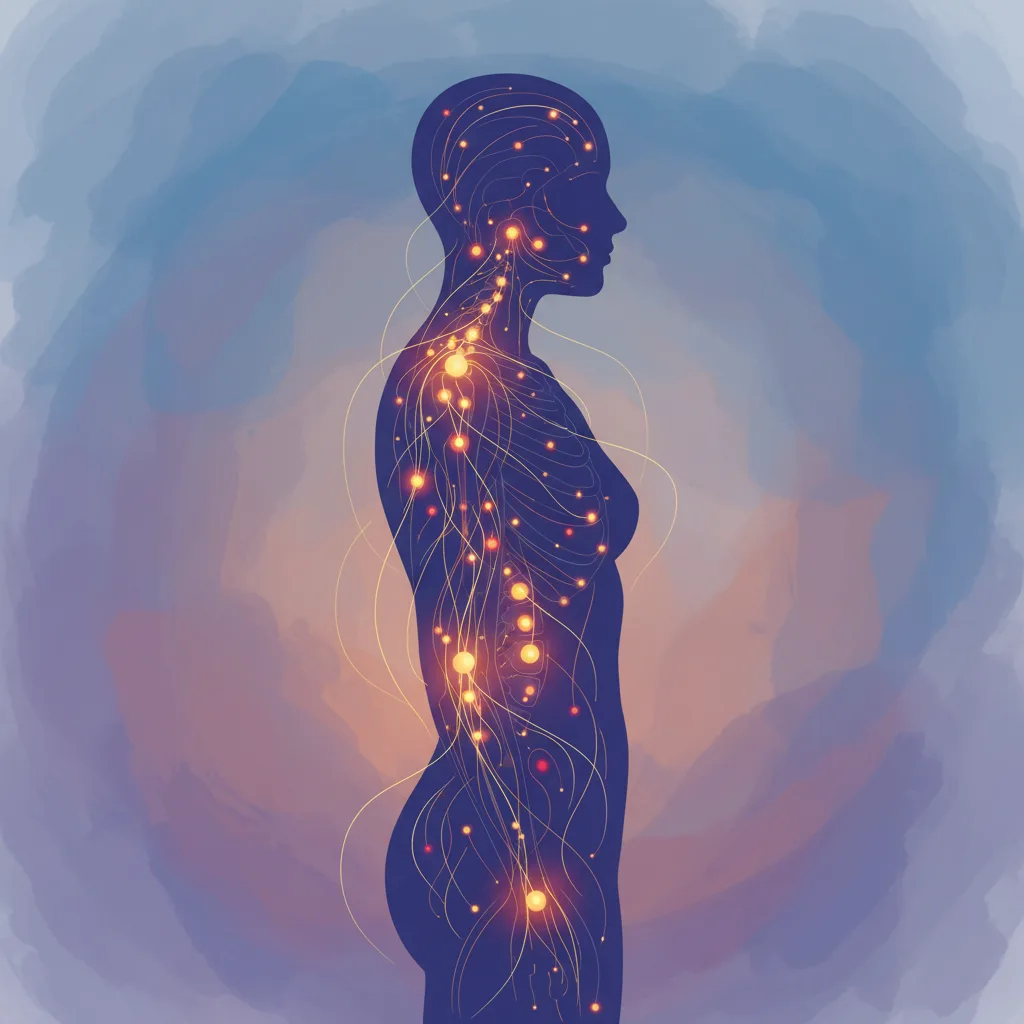
Stress in Your Body: 20 Physical Symptoms You Might Not Recognize
Stress doesn't stay in your head — here's how it manifests from head to toe.

Defining the Problem
The breath is the only autonomic function that can also be consciously controlled, making it a unique bridge between voluntary and involuntary nervous system activity. Research published in the Journal of Neurophysiology (2017) identified a cluster of neurons in the brainstem — the pre-Botzinger complex — that directly links breathing rhythm to arousal states. This neural circuit explains why slow, deep breathing genuinely calms the nervous system rather than merely providing a distraction.
Anticipatory anxiety — worrying about future events — activates the same neural circuits as actual threat exposure. Research published in Science (2006) demonstrated that the anterior insula, a brain region involved in processing aversive experiences, showed equal activation whether participants were experiencing mild electric shocks or merely anticipating them. This finding explains why anticipatory anxiety feels so physically real and why rationalization alone is often insufficient to resolve it.
One practical implication of this research that is often overlooked is the importance of transitional rituals — deliberate practices that mark the boundary between different states of activation. The morning commute, the lunch break, the evening decompression — these transitional periods serve a neurological function by allowing the nervous system to shift between different modes of operation. The erosion of these boundaries in remote work culture, where the laptop opens on the nightstand and closes on the couch, has eliminated many of the natural regulation points that previously structured the day. Deliberately creating transitional rituals (a 10-minute walk between work and dinner, a specific 'shutdown' routine at end of work, different physical spaces for different activities) can significantly improve nervous system regulation even without adding formal 'practices.'
Chronic sympathetic activation creates a cascade of downstream effects that extend far beyond the subjective experience of feeling stressed. Elevated cortisol suppresses immune function, disrupts sleep architecture, impairs memory consolidation in the hippocampus, and promotes visceral fat storage. A landmark study in the Proceedings of the National Academy of Sciences (2004) found that chronic psychological stress was associated with shorter telomere length — essentially accelerating biological aging at the cellular level.
Decision fatigue is not merely a colloquial complaint but a well-documented cognitive phenomenon. A famous study of Israeli parole judges published in the Proceedings of the National Academy of Sciences (2011) found that the probability of a favorable ruling dropped from about 65% at the start of a session to nearly 0% just before a break — then reset to 65% after the break. This research demonstrates that decision-making depletes a finite cognitive resource, and that the depleted brain defaults to the path of least resistance.
The Neuroscience of the Response
The relationship between chronic pain and stress is mediated by shared neural circuits. Research from Northwestern University's Feinberg School of Medicine has shown that chronic pain reorganizes the brain's emotional processing regions, particularly the prefrontal cortex and amygdala. This neurological overlap explains why chronic pain patients frequently develop anxiety and depression, and why effective pain treatment increasingly involves addressing the nervous system's stress response rather than solely targeting peripheral pain signals.
The distinction between stress and anxiety is both neurological and temporal. Stress is a response to an identifiable external stimulus — a deadline, a conflict, a financial setback. Anxiety, by contrast, is the persistence of the stress response in the absence of an immediate threat. Neuroimaging research from the National Institute of Mental Health has shown that anxiety involves hyperactivity in the amygdala and anterior insula even when no threat is present, suggesting that the brain's threat-detection system is firing inappropriately.
For those beginning to explore this territory, the sheer volume of information can itself become overwhelming — paradoxically adding another source of stress. A useful framework is to start with one practice that addresses your most prominent symptom. If your primary issue is racing thoughts, begin with breathwork. If it's physical tension, start with progressive muscle relaxation or somatic movement. If it's emotional reactivity, try a brief daily mindfulness practice. The evidence consistently shows that any single regulation practice, done consistently, produces downstream benefits across multiple domains. You don't need to do everything — you need to do one thing reliably.
The enteric nervous system, sometimes called the 'second brain,' contains over 500 million neurons lining the gastrointestinal tract. This neural network communicates bidirectionally with the central nervous system via the vagus nerve, which is why stress so commonly manifests as digestive symptoms. Research from the Alimentary Pharmabiotic Centre at University College Cork has demonstrated that gut microbiota composition directly influences vagal signaling and, consequently, stress reactivity and mood.
The nervous system doesn't care about your to-do list. It cares about one thing: are you safe right now?
How Your Body Experiences It
Morning anxiety — the experience of waking with a racing heart, tight chest, and sense of dread — has a clear physiological basis. Cortisol naturally peaks 30-45 minutes after waking in what's called the cortisol awakening response (CAR). In individuals with anxiety disorders, this response is amplified, sometimes producing cortisol levels 2-3 times higher than normal. Research published in Psychoneuroendocrinology (2007) found that a heightened CAR was associated with greater perceived stress, worry, and rumination throughout the day.
Doomscrolling exploits a well-documented neurological vulnerability. The brain's threat-detection system prioritizes negative information because, in evolutionary terms, missing a threat was far more costly than missing an opportunity. Social media algorithms amplify this bias by serving increasingly alarming content to maximize engagement. Research from the University of Sussex (2019) found that negative news consumption was associated with increased anxiety, sadness, and catastrophic thinking — effects that persisted for hours after the person stopped scrolling.
The social dimension of regulation cannot be overstated. Humans are fundamentally social regulators — our nervous systems evolved in the context of close-knit social groups where safety was a collective, not individual, achievement. Research from the University of Virginia has demonstrated that holding a loved one's hand during a mildly stressful task reduces both subjective anxiety and neural threat responses (as measured by fMRI) compared to holding a stranger's hand or no hand at all. This effect is dose-dependent, with relationship quality predicting the magnitude of the calming effect. In an era of increasing social isolation, this research underscores the biological necessity of meaningful human connection.
Chronotype — your natural preference for morning or evening activity — is genetically determined and shifts across the lifespan. Research published in Current Biology (2019) identified nearly 400 genetic variants associated with chronotype. Adolescents naturally shift toward later chronotypes (explaining why teens struggle with early school start times), while older adults tend to shift earlier. Forcing yourself to operate against your chronotype has measurable health consequences: a UK Biobank study of 430,000 people found that evening chronotypes forced to wake early had a 10% higher mortality risk.
The Brain Circuits Involved
Social media use and anxiety show a dose-response relationship. A 2018 study in the Journal of Social and Clinical Psychology — one of the first randomized controlled trials on the subject — found that limiting social media to 30 minutes per day for three weeks significantly reduced loneliness and depression. Importantly, the mechanism was not simply reduced screen time but reduced social comparison, suggesting that it's the specific cognitive process triggered by social media, not the activity itself, that drives negative outcomes.
The relationship between chronic pain and stress is mediated by shared neural circuits. Research from Northwestern University's Feinberg School of Medicine has shown that chronic pain reorganizes the brain's emotional processing regions, particularly the prefrontal cortex and amygdala. This neurological overlap explains why chronic pain patients frequently develop anxiety and depression, and why effective pain treatment increasingly involves addressing the nervous system's stress response rather than solely targeting peripheral pain signals.
It's also worth noting that individual variation in response to different regulation techniques is substantial and influenced by factors including genetics, trauma history, attachment style, and current nervous system state. A practice that is deeply calming for one person (such as meditation) may be destabilizing for another (particularly individuals with trauma who may find stillness activating). This is not a failure of the practice or the practitioner — it's a reflection of genuine neurobiological difference. The most effective approach is experimental: try a technique for two to four weeks, track your subjective response, and adjust accordingly.
This finding aligns with a broader pattern in psychophysiology research: the body's regulatory systems are not fixed but remarkably plastic. When provided with consistent, appropriate inputs — whether through breathwork, movement, social connection, or nutritional support — the nervous system can recalibrate toward more adaptive baseline states. The key word here is 'consistent.' Single interventions produce temporary shifts; sustained practice produces lasting change. Research from the University of Wisconsin's Center for Healthy Minds has demonstrated that as little as two weeks of daily practice can produce detectable changes in neural connectivity, with more substantial structural changes emerging after eight to twelve weeks.
Caffeine's relationship with anxiety is dose-dependent and highly individual, influenced by genetic variations in the CYP1A2 enzyme that metabolizes caffeine. Fast metabolizers (about 50% of the population) can consume moderate caffeine without significant anxiety effects, while slow metabolizers may experience jitteriness, increased heart rate, and panic-like symptoms from as little as 100mg (one cup of coffee). Research published in Neuropsychopharmacology (2005) found that caffeine at doses above 200mg significantly increased cortisol secretion in habitual consumers, challenging the common belief that tolerance eliminates caffeine's stress effects.
Risk Factors and Vulnerability
The distinction between stress and anxiety is both neurological and temporal. Stress is a response to an identifiable external stimulus — a deadline, a conflict, a financial setback. Anxiety, by contrast, is the persistence of the stress response in the absence of an immediate threat. Neuroimaging research from the National Institute of Mental Health has shown that anxiety involves hyperactivity in the amygdala and anterior insula even when no threat is present, suggesting that the brain's threat-detection system is firing inappropriately.
The relationship between chronic pain and stress is mediated by shared neural circuits. Research from Northwestern University's Feinberg School of Medicine has shown that chronic pain reorganizes the brain's emotional processing regions, particularly the prefrontal cortex and amygdala. This neurological overlap explains why chronic pain patients frequently develop anxiety and depression, and why effective pain treatment increasingly involves addressing the nervous system's stress response rather than solely targeting peripheral pain signals.
A nuanced understanding of the stress response includes recognizing that not all stress is created equal. Acute, time-limited stress followed by recovery (eustress) actually strengthens the nervous system's regulatory capacity through a process called hormesis — similar to how exercise stresses muscles to make them stronger. The problem arises with chronic, unrelenting stress that prevents recovery, or with traumatic stress that overwhelms the system's capacity to process. This distinction matters for practical decision-making: avoiding all stress is neither possible nor beneficial. The goal is to ensure adequate recovery between periods of activation and to avoid sustained activation without relief.
Gratitude practices have measurable neurological effects. Research using fMRI at Indiana University (2015) demonstrated that gratitude journaling increased activation in the medial prefrontal cortex — a brain region associated with learning, decision-making, and value assessment. Participants who wrote gratitude letters showed greater neural sensitivity to gratitude experiences three months later, suggesting that the practice creates lasting changes in how the brain processes positive experiences.
Anxiety and excitement produce identical physiological responses — increased heart rate, faster breathing, cortisol release. Research from Harvard Business School shows that reappraising anxiety as excitement ('I'm excited' instead of 'I'm nervous') significantly improves performance.
The Role of Chronic Stress
Journaling has surprisingly robust evidence behind it. James Pennebaker's research at the University of Texas demonstrated that expressive writing about stressful events for just 15-20 minutes per day over 3-4 days produced significant improvements in immune function, reduced doctor visits, and improved mood — effects that lasted months. The mechanism appears to involve cognitive processing: writing forces the brain to organize fragmented emotional experiences into coherent narratives, which facilitates meaning-making and emotional resolution.
Morning anxiety — the experience of waking with a racing heart, tight chest, and sense of dread — has a clear physiological basis. Cortisol naturally peaks 30-45 minutes after waking in what's called the cortisol awakening response (CAR). In individuals with anxiety disorders, this response is amplified, sometimes producing cortisol levels 2-3 times higher than normal. Research published in Psychoneuroendocrinology (2007) found that a heightened CAR was associated with greater perceived stress, worry, and rumination throughout the day.
The clinical implications of this research extend beyond individual treatment. Public health interventions increasingly recognize that chronic stress operates at population level, with socioeconomic disadvantage, racial discrimination, and environmental pollution all contributing to collective nervous system dysregulation. A 2020 study in the American Journal of Public Health found that neighborhood-level stressors — including noise, crime, and lack of green space — predicted HRV at the population level, independent of individual-level factors. This suggests that nervous system health is not solely an individual responsibility but also a function of the environments we create and inhabit.
Perfectionism operates as a chronic stress generator because it creates an impossible standard against which all performance is evaluated. Research by Thomas Curran and Andrew Hill, published in Psychological Bulletin (2019), found that perfectionism has increased substantially across generations, with socially prescribed perfectionism (the belief that others demand perfection from you) showing the steepest rise. This form of perfectionism is most strongly associated with anxiety, depression, and burnout because the source of the standard feels external and uncontrollable.
Behavioral Patterns That Make It Worse
Decision fatigue is not merely a colloquial complaint but a well-documented cognitive phenomenon. A famous study of Israeli parole judges published in the Proceedings of the National Academy of Sciences (2011) found that the probability of a favorable ruling dropped from about 65% at the start of a session to nearly 0% just before a break — then reset to 65% after the break. This research demonstrates that decision-making depletes a finite cognitive resource, and that the depleted brain defaults to the path of least resistance.
Social media use and anxiety show a dose-response relationship. A 2018 study in the Journal of Social and Clinical Psychology — one of the first randomized controlled trials on the subject — found that limiting social media to 30 minutes per day for three weeks significantly reduced loneliness and depression. Importantly, the mechanism was not simply reduced screen time but reduced social comparison, suggesting that it's the specific cognitive process triggered by social media, not the activity itself, that drives negative outcomes.
It's also worth noting that individual variation in response to different regulation techniques is substantial and influenced by factors including genetics, trauma history, attachment style, and current nervous system state. A practice that is deeply calming for one person (such as meditation) may be destabilizing for another (particularly individuals with trauma who may find stillness activating). This is not a failure of the practice or the practitioner — it's a reflection of genuine neurobiological difference. The most effective approach is experimental: try a technique for two to four weeks, track your subjective response, and adjust accordingly.
The relationship between chronic pain and stress is mediated by shared neural circuits. Research from Northwestern University's Feinberg School of Medicine has shown that chronic pain reorganizes the brain's emotional processing regions, particularly the prefrontal cortex and amygdala. This neurological overlap explains why chronic pain patients frequently develop anxiety and depression, and why effective pain treatment increasingly involves addressing the nervous system's stress response rather than solely targeting peripheral pain signals.
Evidence-Based Interventions
The breath is the only autonomic function that can also be consciously controlled, making it a unique bridge between voluntary and involuntary nervous system activity. Research published in the Journal of Neurophysiology (2017) identified a cluster of neurons in the brainstem — the pre-Botzinger complex — that directly links breathing rhythm to arousal states. This neural circuit explains why slow, deep breathing genuinely calms the nervous system rather than merely providing a distraction.
Burnout, as defined by the World Health Organization in 2019, is specifically an occupational phenomenon characterized by three dimensions: emotional exhaustion, depersonalization (cynicism toward work), and reduced personal accomplishment. Research from the Karolinska Institute in Sweden has shown that burnout is associated with measurable changes in brain structure — specifically, thinning of the prefrontal cortex and enlargement of the amygdala — changes that mirror those seen in chronic stress and early trauma.
It's worth pausing here to address a common misconception. Many people interpret the science of nervous system regulation as suggesting that we should aim for a permanently calm, parasympathetic-dominant state. This is neither possible nor desirable. The sympathetic nervous system exists for excellent reasons: it mobilizes energy for physical activity, sharpens attention during demanding tasks, and enables rapid response to genuine threats. The goal of regulation is not to suppress sympathetic activation but to ensure that the system returns to baseline after activation — and that the activation itself is proportionate to the actual demands of the situation.
Anticipatory anxiety — worrying about future events — activates the same neural circuits as actual threat exposure. Research published in Science (2006) demonstrated that the anterior insula, a brain region involved in processing aversive experiences, showed equal activation whether participants were experiencing mild electric shocks or merely anticipating them. This finding explains why anticipatory anxiety feels so physically real and why rationalization alone is often insufficient to resolve it.
The Body-Based Approach
Gratitude practices have measurable neurological effects. Research using fMRI at Indiana University (2015) demonstrated that gratitude journaling increased activation in the medial prefrontal cortex — a brain region associated with learning, decision-making, and value assessment. Participants who wrote gratitude letters showed greater neural sensitivity to gratitude experiences three months later, suggesting that the practice creates lasting changes in how the brain processes positive experiences.
Anticipatory anxiety — worrying about future events — activates the same neural circuits as actual threat exposure. Research published in Science (2006) demonstrated that the anterior insula, a brain region involved in processing aversive experiences, showed equal activation whether participants were experiencing mild electric shocks or merely anticipating them. This finding explains why anticipatory anxiety feels so physically real and why rationalization alone is often insufficient to resolve it.
Sleep remains the single most potent nervous system regulation intervention available, yet it is consistently the most neglected. During sleep — particularly during slow-wave and REM stages — the brain undergoes critical maintenance processes: clearing metabolic waste through the glymphatic system, consolidating memories, processing emotional experiences, recalibrating stress hormones, and repairing cellular damage. The research is unequivocal: there is no aspect of physical or mental health that is not impaired by insufficient sleep, and no amount of other regulation practices can compensate for chronic sleep deprivation. Prioritizing sleep is not optional — it is the foundation upon which all other regulation efforts rest.
Journaling has surprisingly robust evidence behind it. James Pennebaker's research at the University of Texas demonstrated that expressive writing about stressful events for just 15-20 minutes per day over 3-4 days produced significant improvements in immune function, reduced doctor visits, and improved mood — effects that lasted months. The mechanism appears to involve cognitive processing: writing forces the brain to organize fragmented emotional experiences into coherent narratives, which facilitates meaning-making and emotional resolution.
The distinction between stress and anxiety is both neurological and temporal. Stress is a response to an identifiable external stimulus — a deadline, a conflict, a financial setback. Anxiety, by contrast, is the persistence of the stress response in the absence of an immediate threat. Neuroimaging research from the National Institute of Mental Health has shown that anxiety involves hyperactivity in the amygdala and anterior insula even when no threat is present, suggesting that the brain's threat-detection system is firing inappropriately.
Cognitive Strategies That Work
Social media use and anxiety show a dose-response relationship. A 2018 study in the Journal of Social and Clinical Psychology — one of the first randomized controlled trials on the subject — found that limiting social media to 30 minutes per day for three weeks significantly reduced loneliness and depression. Importantly, the mechanism was not simply reduced screen time but reduced social comparison, suggesting that it's the specific cognitive process triggered by social media, not the activity itself, that drives negative outcomes.
The breath is the only autonomic function that can also be consciously controlled, making it a unique bridge between voluntary and involuntary nervous system activity. Research published in the Journal of Neurophysiology (2017) identified a cluster of neurons in the brainstem — the pre-Botzinger complex — that directly links breathing rhythm to arousal states. This neural circuit explains why slow, deep breathing genuinely calms the nervous system rather than merely providing a distraction.
The relationship between inflammation and mood is one of the most significant discoveries in psychiatry in the past two decades. Research has demonstrated that approximately one-third of patients with treatment-resistant depression show elevated inflammatory markers, and that anti-inflammatory interventions (including omega-3 supplementation, exercise, and anti-inflammatory diets) can produce antidepressant effects in this subgroup. This 'inflammatory' subtype of depression is characterized by fatigue, psychomotor slowing, and increased sleep — symptoms that differ from the classic 'low serotonin' presentation of decreased appetite, insomnia, and agitation. Recognizing this distinction has important implications for treatment selection.
The glymphatic system, discovered in 2012 by Maiken Nedergaard's lab at the University of Rochester, represents a major breakthrough in understanding why sleep is biologically necessary. During deep sleep, glial cells shrink by up to 60%, expanding the interstitial space between brain cells and allowing cerebrospinal fluid to flush out metabolic waste products — including beta-amyloid, the protein associated with Alzheimer's disease. This cleaning process is almost entirely inactive during wakefulness, making deep sleep literally essential for brain health.
Sources & Further Reading
- Nolen-Hoeksema, S., Wisco, B.E., & Lyubomirsky, S. (2008). Rethinking rumination. Perspectives on Psychological Science, 3(5), 400-424.
- Hunt, M.G., et al. (2018). No more FOMO: Limiting social media decreases loneliness and depression. Journal of Social and Clinical Psychology, 37(10), 751-768.
- Zaccaro, A., et al. (2018). How breath-control can change your life: A systematic review on psycho-physiological correlates of slow breathing. Frontiers in Human Neuroscience, 12, 353.
- McEwen, B.S. (2017). Neurobiological and systemic effects of chronic stress. Chronic Stress, 1, 2470547017692328.
- Curran, T., & Hill, A.P. (2019). Perfectionism is increasing over time: A meta-analysis. Psychological Bulletin, 145(4), 410-429.